
You can't buy a spot in ChatGPT, but you can earn one. When someone asks for a business, ChatGPT searches the web, reads what trusted sources say about the options and recommends the ones it can describe with confidence. To rank, make your business easy to identify, answer your customers' real questions on your site, and get mentioned and reviewed on the sites AI already trusts.
- ChatGPT recommends businesses it can find, understand and verify in more than one place.
- Consistent facts about your business count for more than keywords.
- Pages that answer one question clearly in the first lines are the ones that get quoted.
- Reviews and mentions on trusted sites are the strongest signals you can build.
- Let OpenAI's search crawler read your site, and make sure Bing can index it.
Can you actually rank in ChatGPT?
Yes, in the way that matters to a business owner. ChatGPT has no page two. When a customer asks it for a dentist, a lawyer or a place to get a haircut, it usually names two or three businesses and moves on. If you're one of those names, you've "ranked". If you're not, you're invisible for that question.
For questions like these ChatGPT often runs a live web search before it answers, and it shows the sources it used. That's good news, because it means the answer is built from things you can influence: your website, your listings, your reviews and what other sites say about you.
When we run this check for Miami businesses, we ask the same question five different ways ("best", "near me", "open on Sunday", "that speaks Spanish", "affordable") and note who gets named each time. The businesses that show up in four or five of the answers almost always have the same things in common. The rest of this guide is that list.
How does ChatGPT decide which businesses to recommend?
It works a lot like a careful person doing research. ChatGPT turns the question into one or more searches, reads a small set of pages, keeps the businesses it can confirm in several places and writes an answer that cites its sources.
The question
"Who is the best family dentist in Brickell that speaks Spanish?"
A live search
ChatGPT searches the web through its own index and search partners.
Reading sources
It opens a handful of pages: websites, reviews, directories, lists.
Cross-checking
It keeps businesses whose facts match across several sources.
The answer
It names two or three businesses and links the sources it used.
Three things decide whether you make the cut. The first is whether your business turns up in those searches at all. The second is whether the details match the question: if someone asks for "open late" and nothing online says you are, you lose to a competitor whose site does. The third is agreement. A business described the same way by its website, its Google profile, a local news article and twenty reviews looks safe to recommend. A business with three different names and an empty profile does not.
Answers change from one conversation to the next, and ChatGPT can take the person's location and earlier chats into account. So think in terms of how often you're named across many questions, not one perfect screenshot.
What changes compared with Google SEO?
Most of the groundwork is the same, and good Google SEO helps you in ChatGPT too. The difference is what you're competing for: one of ten links on Google, or one of three names in a written answer.
If you want the bigger picture, our page on generative engine optimization covers the same ideas across Gemini, Perplexity and Google's AI Overviews.
Step 1. Make your business impossible to confuse

AI systems think in entities: one business, with one name, one address, one set of services. If the web describes you three different ways, ChatGPT can't be sure they're the same company, and it won't stake its answer on you.
A salon we looked at appeared as "Bella Salon" on its website, "Bella Hair Studio LLC" on Yelp and "Bella Salon Brickell" on Google, with two different phone numbers. To a person that's obviously one place. To a machine reading quickly, it's three weak businesses instead of one strong one.
- Pick one exact business name, address and phone number, and use them everywhere.
- Write one plain sentence about what you do, where and for whom. Reuse it on your site, your profiles and your social bios.
- Claim and complete Google Business Profile, Bing Places and Apple Business Connect, plus the two or three directories that matter in your industry.
- Give your site a real About page with the founder, the year you started and your address.
- Add Organization or LocalBusiness structured data, with sameAs links pointing to each of your profiles.
Step 2. Answer the questions your customers really ask
ChatGPT quotes pages that answer a question clearly and quickly. Write the answer in the first one or two sentences, then add the detail. That single habit does more for AI visibility than any keyword trick.
Finding the questions is easier than it sounds. Look at what people ask on the phone and in your DMs, the "People also ask" box on Google, and the questions in your reviews. You can even ask ChatGPT what someone should ask before choosing a business like yours.
"At our clinic we believe every smile is unique, and our passionate team is dedicated to providing personalised solutions for all your dental needs."
"Yes, we offer same-day emergency dental appointments in Brickell, Monday to Saturday from 8 a.m. to 7 p.m. Call before noon and we'll usually see you the same afternoon."
Give each main service its own page, with the location in the heading where it's true. Then add an FAQ to those pages, written in the words customers use, and mark it up with FAQ structured data so machines can read each question and answer separately.
Step 3. Get mentioned where AI already looks
When ChatGPT answers "who's the best", it leans heavily on pages that compare options: local news, "best of" lists, industry directories and community threads. Being named on those pages is the closest thing to a backlink in AI search.
- Get into the "best [service] in [city]" lists that already rank for your service. Many are open to suggestions, and some accept a short expert quote.
- Pitch a local angle to neighbourhood blogs and outlets. A new service, a community project or a useful tip is enough.
- Join your chamber of commerce and the trade associations that publish member directories.
- Take part honestly in community forums. One genuinely helpful answer from the owner beats ten anonymous recommendations.
Skip paid link schemes. They tend to put you on pages nobody trusts, which is the opposite of what you need.
Step 4. Collect reviews that say something specific
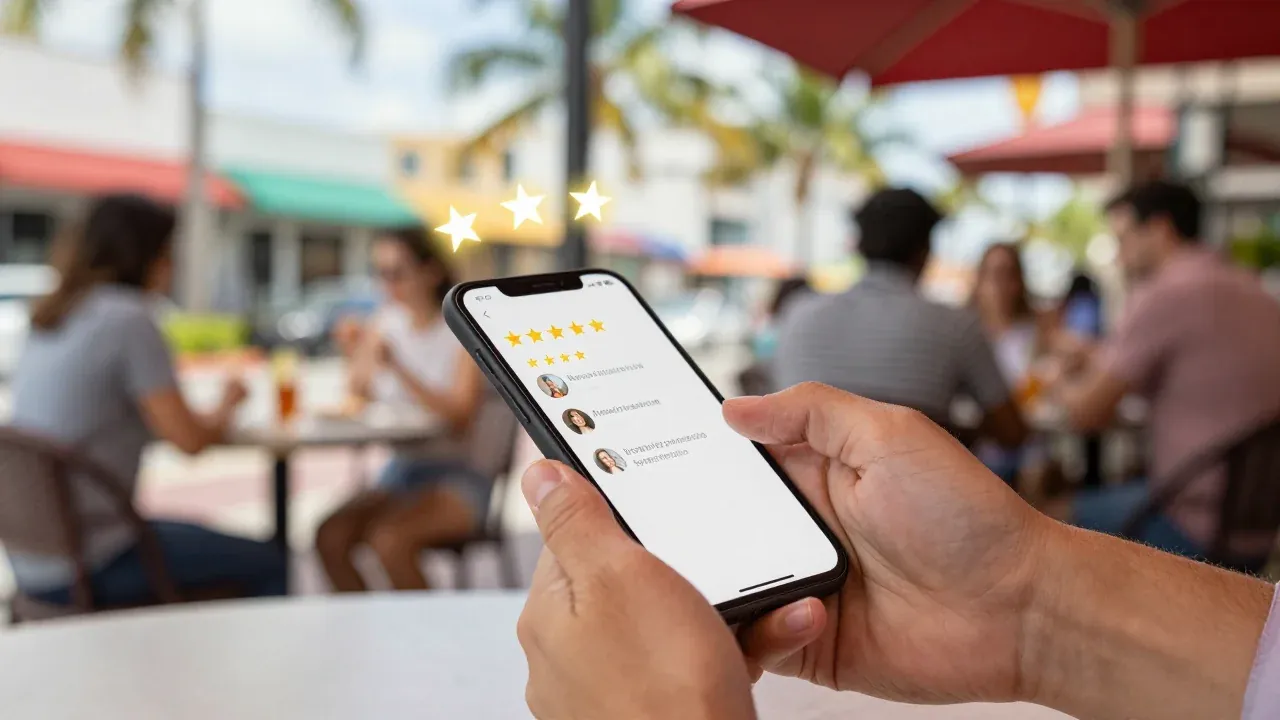
A review that says "Great service!" tells ChatGPT almost nothing. A review that says "They fixed my AC the same day in Coral Gables and explained the price before starting" tells it your service, your area, your speed and your honesty. Those details are exactly what people put in their questions.
You can't write reviews for customers, but you can make the specific ones more likely. Ask a simple question when you request a review, like "What did we help you with?", and the answers get detailed on their own. Reply to reviews too, mentioning the service by name. And spread them out: Google first, then Yelp or the review site that matters in your industry.
Never buy or fake reviews. Since October 2024 the FTC's rule on fake reviews lets it fine businesses that do, and AI systems are getting better at spotting patterns that look staged.
Step 5. Let AI crawlers read your site
This is the step most businesses miss, because nothing looks wrong. Your site works fine for visitors while the crawlers that feed AI answers are quietly turned away.
OpenAI uses separate crawlers for separate jobs. OAI-SearchBot finds pages to show in ChatGPT's search answers. GPTBot collects data for training models. ChatGPT-User visits a page when a person asks ChatGPT to open it. You can allow search and block training if you prefer. A robots.txt that does that looks like this:
User-agent: OAI-SearchBot
Allow: /

User-agent: ChatGPT-User
Allow: /

User-agent: GPTBot
Disallow: /
Robots.txt isn't the only gate. When we tested our own site, the hosting company's CDN was answering AI crawlers with "too many requests" errors, even though robots.txt allowed them. Ask your host or developer to check the server logs for OAI-SearchBot and Bingbot, not just the file.
- Keep important facts in the HTML text: prices, hours, service areas. Not only in images, PDFs or pop-ups.
- Make pages fast and readable without JavaScript tricks, so a crawler sees what a visitor sees.
- Submit your sitemap in Bing Webmaster Tools as well as Google Search Console, since ChatGPT search also draws on third-party search providers.
- An llms.txt file, a short plain-text summary of your site for AI, is cheap to add. Nobody has confirmed that ChatGPT uses it, so treat it as a bonus, not a strategy.
Step 6. Track what AI says about you

You can't improve what you never look at. Once a month, open a temporary chat in ChatGPT, so your history doesn't colour the answers, and ask the ten to twenty questions a customer would ask. Write down whether you're named, who is named instead and which sources are cited. Those sources are your to-do list.
Tools like Ahrefs Brand Radar can automate this at scale. For a single local business a spreadsheet and thirty minutes a month is plenty. Here's the checklist we start every client with. Tick what you already have.
Tick what's already true for your business.
How long does it take to show up in ChatGPT?
Technical fixes, like opening up crawler access and cleaning up your facts, can be picked up within a few weeks, once the pages are crawled again. Mentions and reviews build more slowly. In our experience a local business that works on all six steps usually starts appearing in some answers within two to three months, and more consistently after six. In a crowded market like Miami real estate or personal injury law it takes longer, because the businesses you're up against are doing the same work.
Mistakes that keep businesses out of AI answers
- Blocking AI crawlers by accident, through a security plugin, a CDN setting or an old robots.txt rule.
- Using a slightly different business name or phone number on every platform.
- Writing a homepage full of slogans ("solutions for all your needs") that never says what you do or where.
- Hiding prices, hours and service areas in images and PDFs.
- Trying tricks such as hidden text written for AI. They are easy to detect and can get a site treated as untrustworthy.
Frequently asked questions
Is ChatGPT SEO the same as GEO?
Almost. Generative engine optimization (GEO) is the broader practice of being visible in answers from any AI system, including ChatGPT, Gemini, Perplexity and Google AI Overviews. ChatGPT SEO is GEO focused on one engine. The methods are the same.
Can I pay to be recommended by ChatGPT?
No. ChatGPT's recommendations in its answers are based on what it finds and trusts online, and there is no option to buy a place in them. What you can invest in is the work that makes you easy to find and verify.
Does ranking on Google help me rank in ChatGPT?
Yes, indirectly. ChatGPT search draws on web search results, so pages that rank well are more likely to be found and read. It isn't one to one, though: a business can rank well on Google and still be skipped by ChatGPT if its facts are inconsistent or its reviews are thin.
Do I need an llms.txt file?
It's optional. An llms.txt file is a short summary of your site written for AI systems. It costs almost nothing to add, but there is no public confirmation that ChatGPT uses it, so do the other steps first.
How can I check if ChatGPT recommends my business?
Open a temporary chat and ask the questions your customers would ask, including your neighbourhood and the specific service. Try at least five variations and note who is named and which sources are cited. Or ask us for a free AI visibility check.
Does this work for businesses outside Miami?
Yes. The examples here are from Miami because that's where we're based, but ChatGPT picks businesses the same way in every city.

Founder and CTO of B2Brain, a Miami AI solutions company. Victor works across web development, SEO and AI search, and runs the AI visibility checks behind this guide.
LinkedIn ↗